
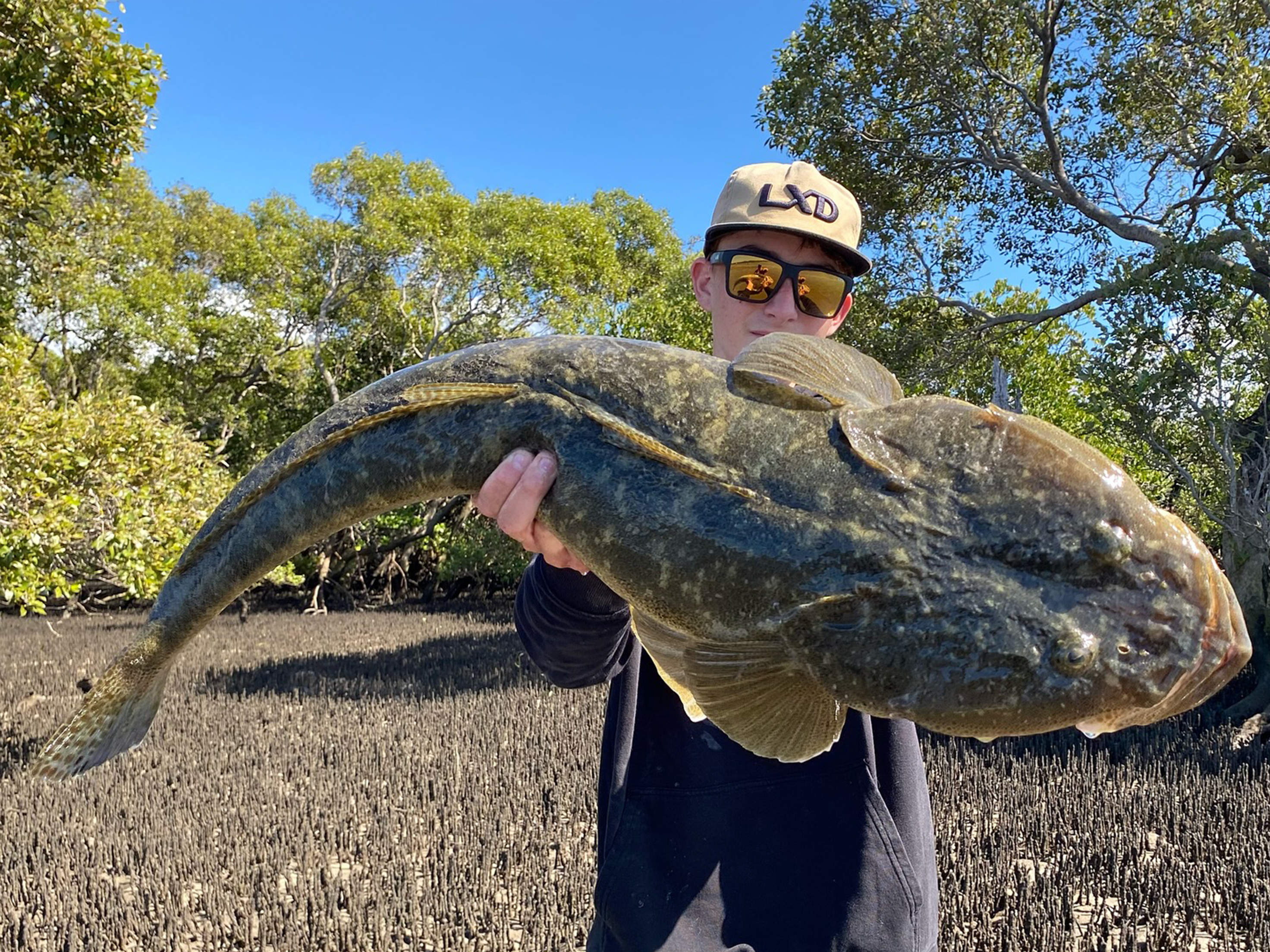
Ask ten anglers what size soft plastic they run for flathead and you'll probably get one answer repeated nine times. Most of us settle on a size that's worked before and stick with it all session, regardless of what the fish are actually doing that day. It's an easy habit to fall into, but it's also one of the simplest reasons a session produces plenty of undersized fish and nothing worth a photo.
Flathead in any given system aren't one uniform population feeding on one uniform size of bait. There are feed fish keyed onto small prawns and baitfish, and there are genuinely big, mature fish with a completely different feeding pattern. Running the same profile all day means you're only ever properly targeting one of those groups.
Two Different Fish, Two Different Targets
Smaller, feed-sized flathead tend to sit in numbers on the flats and around drains, actively working through whatever bait is moving with the tide. They're opportunistic and will eat a smaller profile readily, but they can also be put off by something too large or too aggressive moving through their zone.
The bigger fish, the ones most anglers are actually hoping for, behave differently. A genuinely large flathead has earned its size by being efficient, and efficient usually means committing to a bigger, more calorie-dense meal rather than chasing down something small. These fish are also often sitting deeper, on the edges of channels or tucked into isolated structure, away from the general feeding activity on the flats.
Reading the Signs on the Day
Bait activity is the biggest clue. If you're seeing small prawns skipping on the surface or fine baitfish schools moving through, that's a strong signal the fish actively feeding in that zone are tuned into something small, and downsizing your profile is likely to get more bites. If instead you're marking bigger, more scattered signs on sounder, or fishing deeper edges away from the general bait activity, that's when stepping up in size and profile makes sense.
Time of session matters too. Early and late in the day, when there's more general feeding activity across a system, smaller profiles worked steadily often produce more numbers. In the quieter middle of the day, a bigger, more realistic profile fished slowly through known deep holding water can be what convinces one of the larger, less active fish to commit.
Matching Profile to the Moment
This is less about owning every size in every colour and more about being willing to swap when what you're using isn't producing. A soft plastic range with genuine size options, such as the S Tackle Fish Tail Minnow, makes that adjustment straightforward, since the same realistic profile and action is available in a size that suits finicky feed fish as well as a size built to tempt something considerably larger.
The key is not getting locked into a single size out of habit. If you've had a handful of follows or light taps without a solid hook-up, that's often a sign the size is slightly off for what's feeding in that zone right then, and it's worth changing before you change location.
Rigging Considerations for Bigger Profiles
Stepping up in plastic size usually means stepping up your jig head weight and hook size to match, both to balance the bigger profile properly in the water and to give yourself the hook-holding power a genuinely big flathead demands. A bigger plastic on an undersized jig head will often sit unnaturally and fail to swim properly, undoing the exact advantage you were trying to gain by sizing up in the first place.
Adjusting Through the Session
Bait activity and fish behaviour rarely stay fixed for an entire session, particularly around a tide change. It's worth treating your plastic size as something you actively manage rather than something you set once at the start and forget about. If the bite window opens up and you start getting solid, confident hits on a smaller profile, that's a decent sign there's a school of feed fish actively working the area, and it can pay to stay on that size while the action lasts rather than switching for the sake of it.
Conversely, if you've worked a stretch of water thoroughly with a smaller profile and you're marking bigger, more isolated signs on the sounder without much response, that's the cue to swap up rather than keep persisting with what clearly isn't tempting those fish.
A Simple Two-Rod Approach
If you're fishing from a boat or kayak, having two outfits rigged, one with a smaller, downsized profile and one with a bigger option ready to go, takes a lot of the guesswork out of switching. Rather than stopping to change plastics every time conditions shift, you can simply pick up the rod that matches what you're seeing in front of you and keep fishing without losing time on the water.
The Bottom Line
There's no single size that covers every flathead in a system on every tide. Paying attention to what's actually happening around you, the bait, the depth, the time of day, and being willing to swap profiles rather than persisting with the same plastic all session, is what separates anglers who consistently find the bigger fish from those who catch plenty of feed-sized flathead and wonder why the big one never turns up.
Ready to cover both ends of the size range? Browse the full S Tackle Fish Tail Minnow lineup at stackle.com.au. Fish can't resist the bite.


