
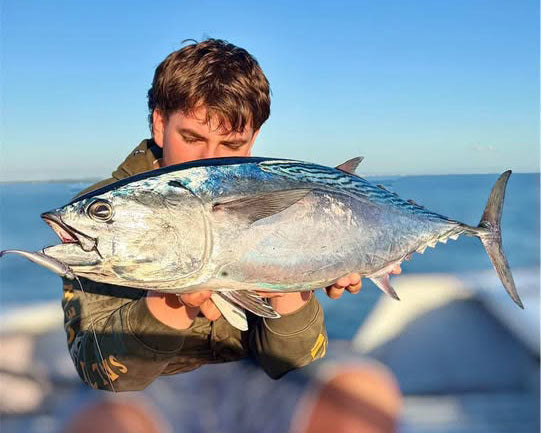
Most beach fishos are set up for whiting and bream. Rod in the sand, bait on the bottom, waiting. And then a school of mack tuna or salmon tears through the gutter in front of them and they have absolutely nothing rigged for it.
Land-based pelagic fishing is one of the most underrated forms of lure fishing in Australia. The fish are accessible, the gear does not need to be complicated, and when a school is running through the wash in front of you the fishing is as exciting as it gets. You just need to be ready for it, and know what you are looking for before it happens.
What Brings Pelagics Into the Surf Zone
Mack tuna, longtail tuna, salmon, tailor and trevally do not come into the surf randomly. They are chasing bait. Schools of whitebait, garfish, and small pilchards get pushed into the wash by currents and wave action, and pelagics follow them in from offshore. The same structure that holds bream and whiting—the gutter edges, rip channels and drain mouths—also funnels bait and concentrates it in predictable spots. When pelagics find that concentrated bait in shallow water, the result is one of the most visual and exciting things you will see in Australian fishing.
The signs are usually obvious if you know what to look for. Birds working low over the water are the giveaway from a distance. Get closer and you will see nervous water, baitfish skipping on the surface, and occasionally the fish themselves crashing through the school from below. Any of those signs means get a lure in the water immediately.
Reading the Beach for Pelagic Action
Pelagics in the surf are not evenly distributed along the beach. They follow the bait, and the bait concentrates in the same spots every time. Rip channels are the most reliable location. As water drains back out through gaps in the sand banks, bait gets swept along with it and pelagics sit just off the rip mouth picking off anything coming through. Points and headlands at the ends of beaches also concentrate bait and are worth targeting early and late in the day.
Walk the beach before you set up. Look at where the gutters run, where rips are pushing out, where the bait is sitting. On a calm morning you can often see schools of whitebait in the wash with the naked eye. Set yourself up within casting distance of those spots and be patient. Pelagics move fast and they will come to you if you are positioned right.
Gear and Rigging for Surf Pelagics
You do not need heavy surf gear for beach pelagic fishing. A 7 to 8 foot spinning rod rated to around 20lb with a quality reel and 20 to 30lb braid is more than capable of handling mack tuna and salmon from the beach. A short fluorocarbon leader of around 30lb gives you abrasion resistance against the fish without putting them off the bite in clear water.
The key rigging consideration is getting your lure into the strike zone quickly and working it at the right speed. Pelagics in the surf are chasing fast-moving bait. Your retrieve needs to reflect that. A slow, bottom-hugging presentation that works perfectly for flathead will be completely ignored by a tuna that is used to chasing things down at speed.
Why Soft Plastics Work on Pelagics
Metal slugs and hard bodies get most of the attention for land-based pelagic fishing, and they work well. But soft plastics are seriously underutilised in this situation and when conditions are right they can be devastatingly effective.
A realistic baitfish-profile soft plastic retrieved fast through a feeding school looks exactly like the whitebait or garfish the fish are already eating. Unlike a metal slug, which has a fixed action, a soft plastic tail keeps moving and pulsing even when you slow down slightly, which gives the fish a fraction of a second longer to commit. In situations where fish are slashing through a school but not fully committing to hard-bodied lures, a soft plastic often gets the eat.
Size matching matters here. If the bait in the water is small, downsize your profile to match. A lure that is significantly larger than the bait the fish are keyed in on will get ignored even when fish are going hard around it.
The Retrieve Technique for Beach Pelagics
Fast and erratic is the starting point for targeting pelagics in the surf. Cast beyond the school if you can, let the lure sink for a beat to get it into the zone, and retrieve quickly with irregular rod twitches to imitate a fleeing baitfish. The fish are already in an aggressive, hunting mindset when they are in a feeding school and the trigger is movement and panic, not subtlety.
If fast retrieves are not connecting, try a cast-and-sink approach. Let the lure sink through the school on a semi-tight line and watch for the line to tick or move sideways. Pelagics will intercept a sinking lure from below, particularly when the school has been worked hard and the fish have become wary of fast-moving presentations near the surface.
Be ready for the bite to happen at any point in the retrieve including right at your feet. In shallow gutters, pelagics will follow a lure almost onto the sand before eating it. Do not lift the rod until you feel the weight of the fish.
Best Timing and Conditions for Beach Pelagics
Dawn is the most reliable window for beach pelagic fishing. Bait schools that have been offshore overnight push into the wash as light improves and pelagics follow them in. The first hour of light on a calm morning with a light onshore breeze is about as good as beach pelagic fishing gets. Dusk can also produce but the morning bite is more consistent.
Swell size matters. A flat, calm day with clean water and a slight onshore breeze concentrates bait in the gutters and makes it easy for pelagics to corral and eat it. Big messy surf breaks up bait schools and makes feeding less efficient for the fish. Aim for two feet of clean swell or less if you can.
The Takeaway
Next time you are at the beach and birds start working low over the water, do not just watch. Have a rod rigged and ready. A fast-retrieved soft plastic in a natural baitfish profile, cast into the middle of a feeding school of mack tuna or salmon, is one of the most satisfying bites in Australian fishing. And it is happening on beaches up and down the east coast every winter morning for those who are set up for it.
Browse the full S Tackle soft plastic range at stackle.com.au. Aussie-designed, battle-tested, and just as at home in the surf as it is in the estuary.


